

Ever wonder how one event in the early 1930s sparked battles that changed the fate of nations? This timeline walks you through key moments between 1933 and 1945. We look at shifts in power, major conflicts, and decisive victories that reshaped lives and countries around the world. Follow along to see how these rapid events transformed global history from start to finish.
World War II Timeline: Chronological Overview of Key Events
This timeline runs from 1933 to 1945. It marks major changes that reshaped countries and lives around the world. This guide starts with early shifts in power and goes through landmark battles, ending with the celebrations of victory.
| Year | Key Event |
|---|---|
| 1933 | Adolf Hitler becomes Germany’s Chancellor |
| 1934 | Germany starts rearming, boosting its army and navy |
| 1935 | Italy invades Abyssinia in October |
| 1936 | German forces remilitarize the Rhineland |
| 1937 | Germany, Italy, and Japan sign a pact to cooperate |
| 1938 | The Munich Agreement shows the peak of appeasement |
| 1939 | Germany invades Poland, prompting Britain and France to declare war |
| 1940 | The Dunkirk evacuation, Battle of Britain, and Blitz take place |
| 1941 | Japan strikes Pearl Harbor; Germany declares war on the U.S. |
| 1942 | Key battles at Midway and El Alamein turn the tide |
| 1943 | The Warsaw Uprising begins against German rule |
| 1944 | Allied forces land in Normandy on June 6 |
| 1945 | Victory in Europe Day and VJ Day signal the war’s end |
These dates capture decades of fast change. They show how political moves and military plans evolved, from the rise of dictatorial powers through large-scale battles to the final celebrations of peace.
Detailed Timeline by Theater and Major Aspects
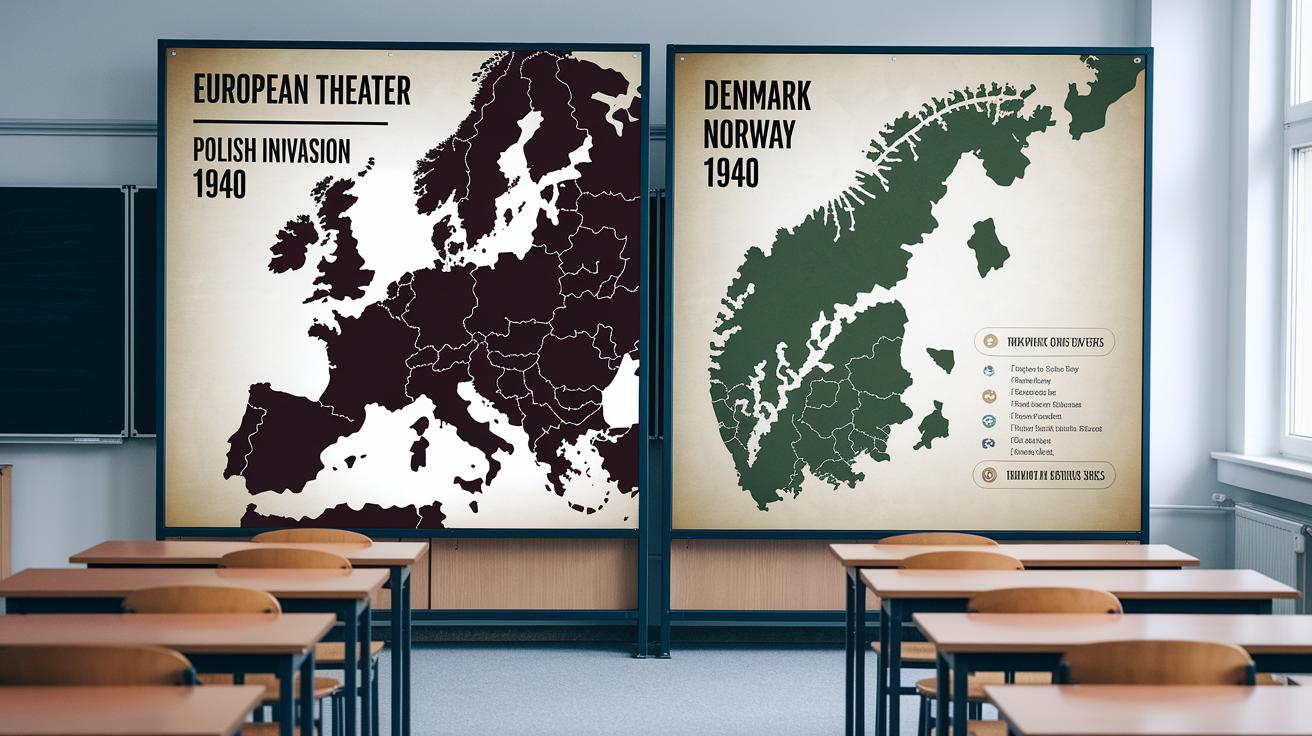
This timeline breaks down World War II into five main parts: the European Theater, Pacific Theater, Diplomatic Milestones, Home Front Changes, and Post-Conflict Recovery. Each section lists key events with dates and quick summaries, showing how military moves, political decisions, and social shifts steered the war.
European Theater Timeline
- September 1939: Germany attacked Poland, sparking war across Europe and drawing in the Allied countries.
- April 1940: In Operation Weserübung, Germany moved into Denmark and Norway to secure important resources and ports.
- May 1940: Blitzkrieg tactics overwhelmed Belgium, the Netherlands, and France, forcing quick surrenders.
- June 1940: France gave in, leaving Britain to stand alone against the Axis powers.
- June 22, 1941: Operation Barbarossa began a massive invasion of the Soviet Union that changed the Eastern Front with fierce battles.
- August 1942–February 1943: The Battle of Stalingrad turned the fight on the Eastern Front, as the Soviet defense slowed down the German push.
- July 1943: The Allied landing in Sicily (Operation Husky) opened a new front in Southern Europe, challenging Axis control in the Mediterranean.
- June 6, 1944: D-Day launched a large amphibious assault in Normandy and gave the Allies a key foothold in occupied France.
- April 16–May 2, 1945: The Battle of Berlin marked the last stand of Nazi Germany with intense street fighting leading to collapse.
- May 8, 1945: Victory in Europe Day (VE Day) ended the war in Europe and started the process of recovery.
Pacific Theater Timeline
- December 7, 1941: The Pearl Harbor attack pushed the United States into the war, shifting power in the Pacific.
- May 7–8, 1942: The Battle of the Coral Sea stopped the Japanese push, showing that coordinated Allied forces could protect key areas.
- June 4–7, 1942: At the Battle of Midway, American forces destroyed Japanese carriers, changing naval strategies for the fight ahead.
- August 1942–February 1943: The Guadalcanal Campaign marked the start of island-hopping, which pushed back Japanese advances and secured vital islands.
- November 1943: The invasion of Tarawa highlighted the harsh conditions and the high cost of capturing strategic islands.
- June 1944: Known as the Marianas Turkey Shoot, this battle saw Allied air power greatly reduce Japanese aircraft and weaken their defenses.
- February 19–March 26, 1945: Intense battles on Iwo Jima over strategic airfields helped the Allies move closer to air dominance near Japan.
- April 1–June 22, 1945: The battle for Okinawa showcased some of the fiercest fighting in the Pacific and paved the way for a potential invasion of Japan.
Diplomatic Milestones
- August 14, 1941: The Atlantic Charter was announced, setting shared goals among the Allies for a postwar world.
- November 22–26, 1943: The Tehran Conference saw top Allied leaders meet to coordinate their strategies across different theaters.
- February 4–11, 1945: At the Yalta Conference, leaders planned how to reorganize Europe after the war, influencing borders and governments for years to come.
- July 17–August 2, 1945: The Potsdam Conference finalized the terms for Axis surrender while outlining plans to reshape the international order.
- October 24, 1945: The United Nations Charter went into effect, providing a framework for global cooperation to prevent future large conflicts.
Home Front Developments
- September 1939: Britain began food rationing, which changed daily life and highlighted the importance of saving resources.
- January 1942: The U.S. War Production Board was formed to shift American industry toward war needs, boosting production.
- January 1943: The Casablanca Declaration helped boost Allied morale by calling for decisive action and unity.
- February 1944: The growth of the Women’s Army Corps showed how women were stepping up with new roles to support the military.
- June 1945: The GI Bill was signed to help returning soldiers, laying the groundwork for major social and economic changes after the war.
Post-Conflict Recovery
- May 8, 1945: VE Day confirmed Germany’s surrender, marking the start of rebuilding in Europe.
- September 2, 1945: VJ Day marked the end of fighting in the Pacific and shifted the focus to reconstruction.
- November 20, 1945: The Nuremberg Trials began, holding war criminals accountable and setting new legal standards.
- April 3, 1948: The Marshall Plan was proposed to give economic help to Europe and jumpstart recovery.
- April 4, 1949: The founding of NATO brought nations together for mutual defense in the new global order.
These events, from fierce battles and strategic landings to key diplomatic meetings and home front changes, all played a crucial role in shaping the outcome of World War II and the world that followed.
Final Words
In the action from Hitler’s rise in 1933 to victory celebrations in 1945, we explored a timeline of world war 2 events. The post outlined key dates and milestones in Europe, the Pacific, diplomatic talks, home front shifts, and post-war recovery.
Each section showed how battles, policy shifts, and recovery efforts influenced the global conflict. The clear breakdown helps busy readers quickly grasp how these moments shaped history. Stay informed as you review the timeline of world war 2 events that defined a turbulent era.
FAQ
Q: What is the timeline of major World War II events from 1939 to 1945?
A: The timeline spans from Germany’s invasion of Poland on September 1, 1939, through pivotal events like Dunkirk, Pearl Harbor, D-Day, and concludes with Victory in Europe on May 8, 1945, and VJ Day on September 2, 1945.
Q: How does the timeline of World War II events unfold in order?
A: The timeline starts with the 1939 invasion of Poland, then includes rapid military advances, key battles, diplomatic moves, and ends with the surrender of Axis powers, reflecting a complex series of military and political events.
Q: When did World War II start?
A: World War II began on September 1, 1939, when Germany invaded Poland, triggering Britain and France to declare war and starting a global conflict.
Q: What were the main events at the beginning of World War II?
A: Early events included Germany’s swift invasion of Poland, the Blitzkrieg tactics that overwhelmed many European nations, and the subsequent evacuation efforts like Dunkirk, which set the stage for the global war.
Q: Which series of events leading to World War II is in the correct chronological order?
A: The correct order starts with rising tensions during the early 1930s, followed by rearmament, diplomatic events like the Munich Agreement, and culminates with the invasion of Poland in 1939 that sparked the war.
Q: How does the World War I timeline differ from the World War II timeline?
A: The World War I timeline (1914–1918) features different causes, battles, and outcomes, while the World War II timeline (1939–1945) covers new conflicts and strategies following the interwar period and reflects a separate global conflict.