
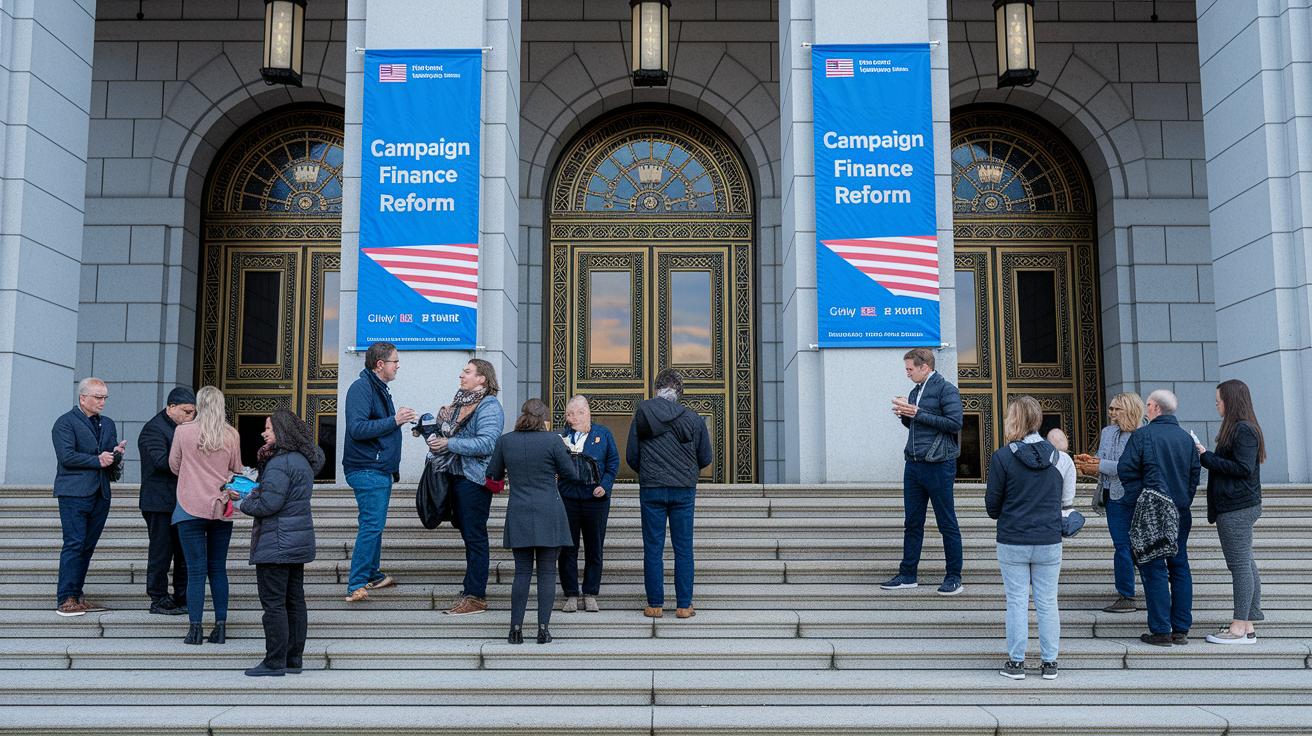

Who really controls our elections? A 2024 poll shows many Americans worry that unchecked spending is hurting our democracy. Billions of dollars flow in with little oversight, and secret donations are shaking public trust. This hidden spending raises a clear question: shouldn't fairness be at the center of our political process? In this article, we explain how setting spending limits and demanding full transparency could steer our elections back to serving the public interest.
Why Campaign Finance Reform Matters Today
A 2024 poll of 1,000 Americans found that 75% believe unlimited spending weakens democracy. Many worry that huge, unregulated donations give powerful interests an unfair edge. This rising anxiety shows a deep distrust in a system where money often drives decisions instead of the public good.
Independent spending jumped dramatically, from $500 million in 2008 to $4.5 billion in 2024 after a key court ruling. On top of that, over $1.3 billion came from undisclosed sources in the latest cycle. When funds move in secret, it’s hard for people to know who is really behind the elections. Imagine billions of dollars spent in secret, quietly shaping policy with no clear accountability.
Experts say strict spending limits and full disclosure are needed to restore fairness. By setting clear contribution caps and enforcing transparent reporting, we can cut hidden influences and keep elections fair for everyone.
Campaign Finance Reform: A Historical Timeline

For more than 150 years, U.S. rules on campaign money have changed in steps to lessen money’s hold on politics. Even back in 380 BC, Plato mentioned that wealth could influence leaders. In American history, we see a similar idea in 1758 when George Washington used wine and cider to secure his spot in the Virginia House of Burgesses. This early event shows that money played a role even then.
In 1867, lawmakers set a clear limit. They banned government officials from asking naval-yard workers for money. This rule marked the beginning of stricter controls over fundraising.
Later reforms built on this foundation. The Federal Election Campaign Act of 1974 and the Bipartisan Campaign Reform Act of 2002 introduced clear rules. They helped limit soft-money donations and made campaign practices more transparent.
The table below summarizes these major moments and shows how each step has shaped today’s conversation about money in politics.
| Year | Law/Decision | Key Impact |
|---|---|---|
| 380 BC | Plato’s Republic | First recorded warning of corruption risk |
| 1758 | Washington’s campaign purchase | Early influence of money |
| 1867 | Naval-yard solicitation ban | First federal limit on fundraising |
| 1974 | Federal Election Campaign Act | Established contribution and disclosure rules |
| 2002 | Bipartisan Campaign Reform Act | Restricted soft-money and ads |
Major Legislative Proposals in Campaign Finance Reform
Lawmakers and reform advocates are looking at new steps to cut big money’s influence in elections. They want to fix rules that let unchecked spending skew the democratic process. The proposals aim to set clear limits and bring back transparency in campaign finance so that money does not drown out the voice of the people.
Key ideas include stricter donation caps and rules to stop secret coordination. One plan would set firm limits on donations from individuals and groups, and it would close gaps that let political parties work with candidates behind the scenes. For instance, the National Republican Senatorial Committee v. FEC case (a legal case that examined party-candidate relationships) showed how such teamwork could let large contributions sidestep current rules and give special interests an unfair advantage.
Other plans suggest public financing models like matching funds or voucher systems. Under these ideas, candidates could get public money to boost small-dollar contributions. In a matching funds program, a small donation could have twice the impact, allowing candidates supported by their community to compete fairly without relying on big private donors.
There is also a push for stronger ethics and enforcement measures. Critics call for clear ethical rules for judges and even suggest setting 18-year term limits for Supreme Court appointments. Better oversight could help everyone follow the rules and keep elections fair and transparent.
Judicial Impact on Campaign Finance Reform

In a 5-4 decision, the Supreme Court reshaped campaign finance rules with the Citizens United ruling. The court argued that limits on corporate spending in elections clash with free speech rights. This view has sparked a debate on balancing free expression with measures designed to keep elections fair. For more background on spending trends, see earlier sections.
Recent cases, like NRSC v. FEC, are now testing other parts of campaign finance law. These challenges focus on how much coordination campaigns can have with their funding sources. Courts are set to better define the balance between free speech and accountability in political financing.
Advancing Transparency in Campaign Finance Reform
New digital tools are changing how we track campaign funds. Reports of $1.3 billion in unaccounted money have sparked calls for strict disclosure rules. Lawmakers and experts now suggest using real-time reporting portals so citizens can watch donations as they flow in. For instance, a live log of contributions can show who is financially backing a campaign.
Improved audit methods are set to boost fairness in fundraising. Advocates want the Federal Election Commission to get more power to check and verify donation records. A system that tracks every donation can reveal any hidden transactions. One proposal calls for regular financial checks to ensure every dollar is recorded, giving voters a clear paper trail.
Oversight agencies play a key role in enforcing these rules. By examining contributions and keeping an eye on financial activity, they can help stop undisclosed donations. Strong oversight means all funding sources are out in the open, lowering the risk of secret influences. With real-time reporting, thorough audits, and determined agency action, tracking campaign funds becomes more transparent and helps keep political financing fair.
Expert Discussions and Future Directions for Campaign Finance Reform

A new online experiment brought together 16 experts via email to openly discuss how to improve campaign finance rules. Their public exchange is preserved for both lawmakers and citizens, adding valuable insights to ongoing research on democracy and governance.
The experts pointed out that the current flow of funds can make elections less fair. They called for tighter checks to reduce secret coordination between political parties and candidates. They also stressed that clear, real-time financial tracking could boost transparency. One expert noted, "Clear reporting tools can help voters see the origin of every contribution."
Looking ahead, the group expects fresh changes to funding rules that could protect election integrity. They are exploring ideas like automated audit portals and enhanced disclosure methods. Their shared vision is to refine campaign finance regulations so that elections stay fair and resilient against undue influence.
Final Words
In the action, the post explored public concerns about modern political funding limits and growing independent spending.
Data and historical milestones underline the need for stricter spending controls.
Legislative proposals stress the importance of donation caps, new financing models, and ethical oversight.
Judicial rulings and transparency measures remind us of the ongoing challenges in regulating dark money.
Expert discussions offer fresh insights to improve policies.
All these elements reinforce that campaign finance reform is critical for a fair political process and a healthier democracy, leaving us optimistic about meaningful change ahead.
FAQ
What is campaign finance reform 2024?
Campaign finance reform in 2024 targets reducing rising spending and dark money by tightening donation limits and boosting oversight, aiming to restore trust in the electoral process.
What are the pros and cons of campaign finance reform?
Campaign finance reform brings benefits such as increased transparency and reduced undue influence, while its drawbacks include challenges to free speech and higher compliance costs for candidates.
How does the Supreme Court influence campaign finance reform?
The Supreme Court shapes campaign finance reform through decisions like Citizens United, which affect rules on corporate spending and dark money, thereby setting legal limits on political contributions.
What is a simple definition of campaign finance reform?
Campaign finance reform means changing laws that govern how money is raised and spent in elections, promoting fairness and accountability in political campaigns.
What is the Campaign Finance Reform Act?
The Campaign Finance Reform Act is a law designed to regulate political spending, set contribution limits, and ensure transparent funding practices to reduce corruption risks.
What is the purpose of campaign finance reform?
The purpose of campaign finance reform is to curb excessive spending, increase transparency, lessen the influence of wealthy donors, and protect the integrity of elections.
What are examples of campaign finance reform?
Examples of campaign finance reform include laws that place limits on contributions, require donor disclosure, and restrict undisclosed or dark money in political campaigns.
What are key campaign finance reform laws?
Key laws include the Federal Election Campaign Act and the Bipartisan Campaign Reform Act, as well as recent proposals aimed at curbing dark money and unrestricted spending.